

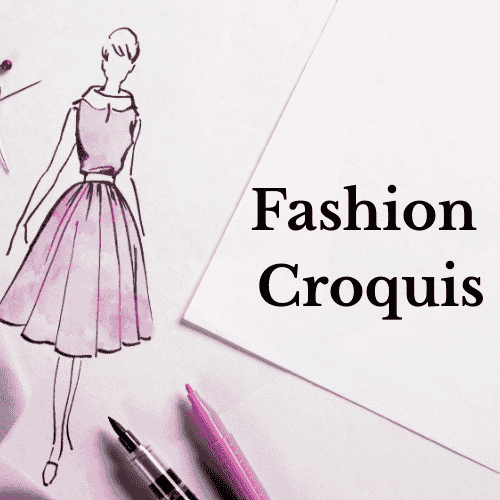
Fashion design doesn’t begin with fabric or thread. It starts with an idea sketched onto paper. A fashion croquis (pronounced “crow-kee”) is a quick sketch of the human figure used in fashion illustration. Unlike a realistic body drawing, croquis are elongated and stylized to showcase garments more dramatically. Every aspiring designer, whether self taught or formally trained, eventually learns how to draw and use croquis. They use them as templates to draw dresses, jackets, pants, or full collections.
Features:
- Usually 9–10 head lengths tall, making the figure taller than a real person.
- Simplified details, focusing on shape and posture.
- Drawn in standing poses that highlight clothing lines.
- Reusable templates that can be traced over for multiple designs.
Why Designers Rely on Croquis
They serve practical purposes which is one of the biggest reason that an professional person depend on it a lot.
- Visualization: They help bring abstract ideas to life.
- Proportion: Elongated forms highlight garment drape, length, and cut.
- Speed: Croquis make sketching faster since designers don’t redraw the figure every time.
- Communication: They make it easier to share ideas with clients, colleagues, or pattern makers.
Standard Proportions
In fashion illustration, designers use “head units” to keep figures proportional. Below is a typical breakdown:
| Body Part | Proportional Length (in head units) | Notes |
| Head | 1 | Standard starting unit |
| Bust | 1 | Shoulder to chest |
| Waist | 1 | Chest to mid-waist |
| Hips | 1 | Mid-waist to hips |
| Thighs | 2 | Longer than real human proportion |
| Calves | 2 | Extended for effect |
| Feet | 2 | Completed stance |
In total, this makes the croquis figure about 9–10 heads tall — taller and slimmer than real body measurements, which usually fall closer to 7–8 heads.
Types of Fashion Croquis
Designers create different croquis depending on what they want to showcase:
- Basic: Neutral standing pose, most common for general design.
- Action Pose: Figures in movement to show how fabric flows.
- Plus-Size: Templates with fuller proportions to design inclusive clothing lines.
- Male: Broader shoulders, different muscle structure, shorter leg extension.
- Children’s: Rounder forms and smaller head-to-body ratio.
Each type helps in visualizing garments for specific markets.
How to Draw a Simple
For beginners, the process can feel intimidating, but breaking it down step by step makes it easier:
- Start with a vertical line — the balance line of the body.
- Divide into head units — mark out 9 or 10 sections.
- Sketch basic shapes — ovals for the head, rectangles for the torso, lines for arms and legs.
- Add outlines — connect shapes to form a fluid silhouette.
- Refine posture — add hip tilt, arm bend, or leg angle.
- Light details — keep facial and hand features minimal.
Once the figure is ready, it can be copied, traced, or scanned as a template.
Stuff for Improving this Skills
- Practice daily sketches, even if rough.
- Use fashion magazines or runway images as reference for poses.
- Trace over existing croquis to train your hand.
- Experiment with different body types to broaden design flexibility.
- Keep proportions consistent, but don’t obsess over perfection.
Usage in the Current Era
Traditionally, croquis were drawn by hand on paper. Today, many designers use digital tools. Programs like Adobe Illustrator, Procreate, or specialized fashion design apps provide ready made templates that can be customized.
Advantages of digital modifications:
- Easy resizing and editing.
- Layering options to try multiple designs.
- Faster color and texture application.
- Professional look for portfolios and presentations.
Still, hand drawing remains valuable for developing creativity and understanding proportions.
Differences Between Fashion Croquis and Flat Sketches
Many beginners confuse it with flat sketches. Here’s how they differ:
| Croquis | Flat Sketch | |
| Figure Base | Stylized human body | No body, just garment outline |
| Purpose | Visualization, concept building | Technical details for production |
| Proportions | Elongated for drama | Accurate to real measurements |
| Use in Industry | Concept boards, portfolios | Pattern making, factory instructions |
Both are essential, but croquis focus more on creativity, while flat sketches focus on technical accuracy.
Famous Designers Who Rely on it
Almost every major designer has leaned on that during early stages. From Coco Chanel to Alexander McQueen, sketchbooks filled with croquis have been the starting point of entire collections. In fashion schools worldwide, mastering drawing is still considered a foundation skill.
Learning this Helps Beginners
For students or hobbyists, practicing croquis has multiple benefits:
- Builds confidence in sketching figures.
- Helps translate mental images into visual drafts.
- Lays groundwork for more advanced illustration.
- Creates a personal “library” of templates for future use.
Even outside professional fashion, tracing can be a creative outlet, mixing art with clothing imagination.
A fashion croquis is definitely a designer’s canvas for creativity. With its elongated form and simplified features, it allows clothes to shine while giving structure to design ideas. From traditional hand drawn figures to digital templates, this remain a main tool for students, professionals, and hobbyists alike.